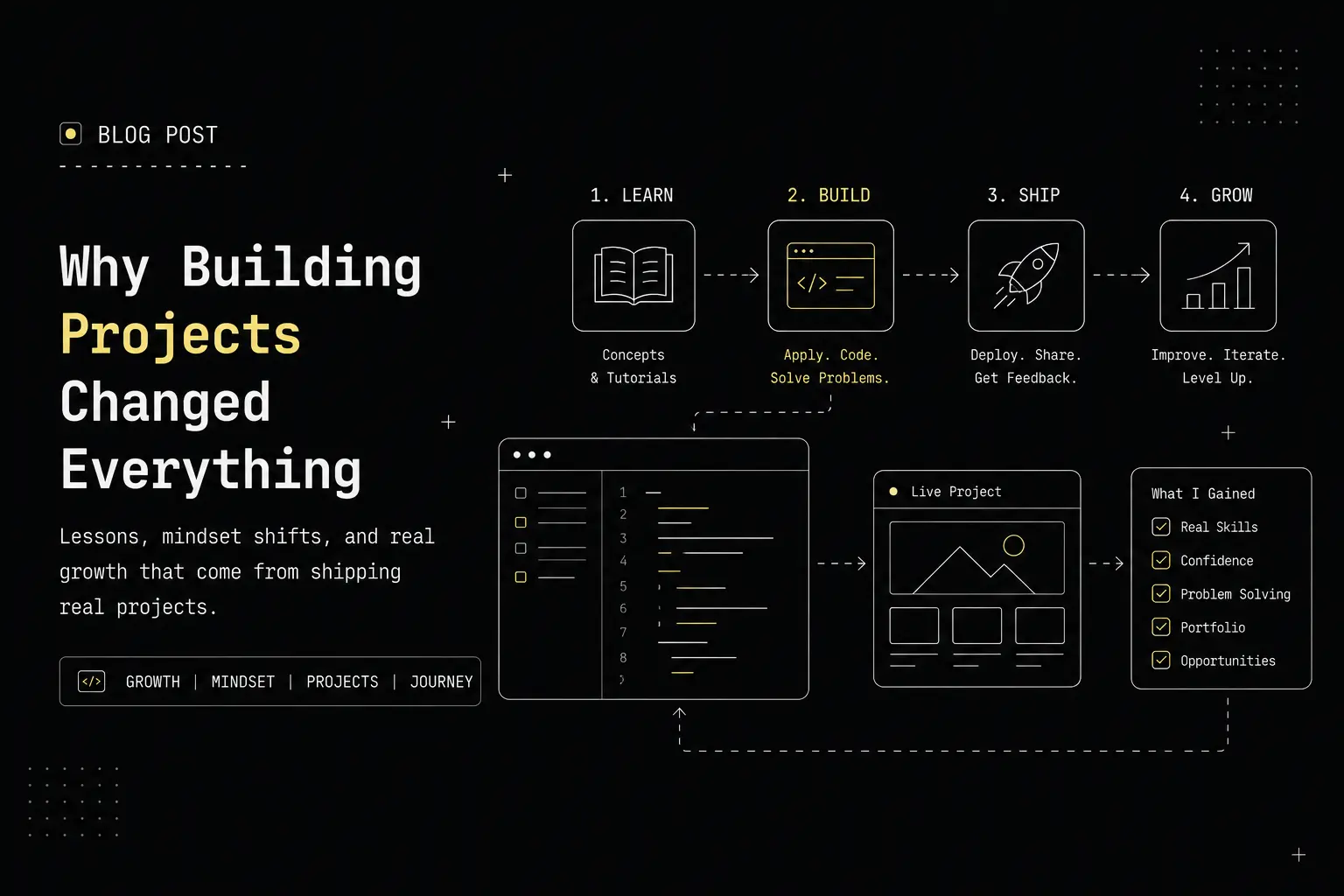
For six months, I thought I was learning web development. In reality, I was just getting better at copying code.
I could follow along with any tutorial. My folders were full of projects. But when I sat down to build something on my own, I'd stare at a blank screen, not knowing where to start.
The Tutorial Trap
I started with Code with Harry's Sigma Web Development course. The pattern was simple: watch, code along, move to the next video. I completed HTML and CSS this way. Then came a one-month exam break.
When I returned, I couldn't recall half of what I'd "learned."
I pushed forward into JavaScript with Chai aur Code, repeating the same cycle. Watch. Copy. Next video. I felt productive, but something was off—I was learning how to follow instructions, not how to code.
The Project That Exposed Everything
I decided to test myself by building Bistro Bliss, a food ordering website using just HTML, CSS, and JavaScript. No frameworks, no tutorials.
The concept was straightforward: users could browse food items and place orders, while admins could view orders and add new items to the menu. I'd built similar features by following tutorials before. How hard could it be?
Extremely hard, it turned out.
I spent hours figuring out how to structure the admin and user interfaces separately. The cart functionality broke every time I tried adding items—items would duplicate randomly, quantities wouldn't update correctly, and refreshing the page wiped everything. I didn't know how to persist data without a backend, so I attempted using localStorage, but my implementation was a mess of nested functions that didn't work half the time.
The CSS layout looked fine on my laptop but completely broke on mobile. I had no idea how to debug it. I'd never learned responsive design—I'd only copied flex and grid properties from tutorials without understanding when or why to use them.
After two frustrating weeks, I had something that kind of worked, but it was fragile, ugly under the hood, and embarrassing. The code was a graveyard of commented-out attempts and hacks I didn't understand.
That's when it hit me: I could follow instructions, but I couldn't solve problems.
The Turning Point
I tried jumping to React, thinking a framework would somehow make things easier. It didn't. I could write useState and pass props between components because I'd copied it dozens of times, but I didn't understand when to lift state up or why one component needed data from another. I was just following patterns without grasping the logic behind component architecture.
Then I moved to Node.js. Same story. I could copy-paste Express routes and connect a database, but I had no idea how the server actually worked, what MVC architecture meant beyond the acronym, or why APIs were structured the way they were. The code ran, but I couldn't explain what it was doing.
Six months in, I had completed dozens of tutorial projects but couldn't build a single feature independently. I finally admitted the truth: I wasn't learning to code. I was learning to copy.
That realization stung, but it also clarified everything. I needed to change my entire approach.
What I Learned
Those six months taught me what doesn't work: watching someone code isn't the same as coding. Understanding comes from struggling through problems yourself, not from seeing someone else solve them.
How I Actually Started Learning
Using AI as a Study Partner
I didn't abandon tutorials, but I stopped treating them as the main source of learning. Instead, I started using AI strategically:
- Breaking down concepts: I'd share tutorial videos and ask AI to explain complex parts in simpler terms, making sure I actually understood before moving on.
- Getting practice problems: After each concept, I'd ask for exercises to test myself—not just reading or watching, but doing.
- Debugging my thinking: When stuck, I'd explain my approach to AI and ask where my logic was wrong. This forced me to articulate my thought process.
- Understanding, not just copying: I focused on the why behind solutions, not just the syntax.
AI didn't replace my thinking—it challenged it. The difference between using AI as a crutch and using it as a tool is whether you're asking it to solve problems for you or help you understand how to solve them yourself.
Building Without a Safety Net
My new approach was simple but uncomfortable:
- Learn the concept through a tutorial or documentation
- Close the tutorial and build something small using that concept
- Struggle through it, only looking things up when genuinely stuck—not at the first sign of difficulty
- For tutorial projects: watch the final result, then build it myself first before watching the implementation
- Add something extra that wasn't in the tutorial—a feature, an improvement, anything to make it mine
This forced me to think like a developer, not a copy-paste machine. It was slower and more frustrating, but I was finally learning.
What Actually Works
What doesn't work:
- Following tutorials without building on your own
- Thinking completion equals understanding
- Jumping between technologies when things get hard
- Collecting projects instead of solving problems
What works:
- Building things badly at first, then improving them
- Struggling through problems before looking up solutions
- Using AI and tutorials as tools, not crutches
- Testing yourself constantly with real projects
- Adding your own features to prove you understand
The Real Lesson
Those six months taught me something no tutorial could: you don't learn web development by watching it—you learn it by building it.
Tutorials are maps, not the journey. AI is a guide, not a replacement for thinking. And courses are starting points, not finish lines.
The moment I stopped trying to complete everything and started trying to build anything, I actually became a developer.
If you're stuck in tutorial hell, here's the truth: No course will teach you what one messy, broken project can.
Stop collecting certificates. Start breaking things.
That's where real developers are made.
This is my story—six months of struggle, one painful realization, and the approach that finally worked. Your path might look different, but if you're stuck in the same cycle I was, I hope this helps you break free.